
Neuronum Cybernetics UG
Introducing the Secure Agent Session (SAS)
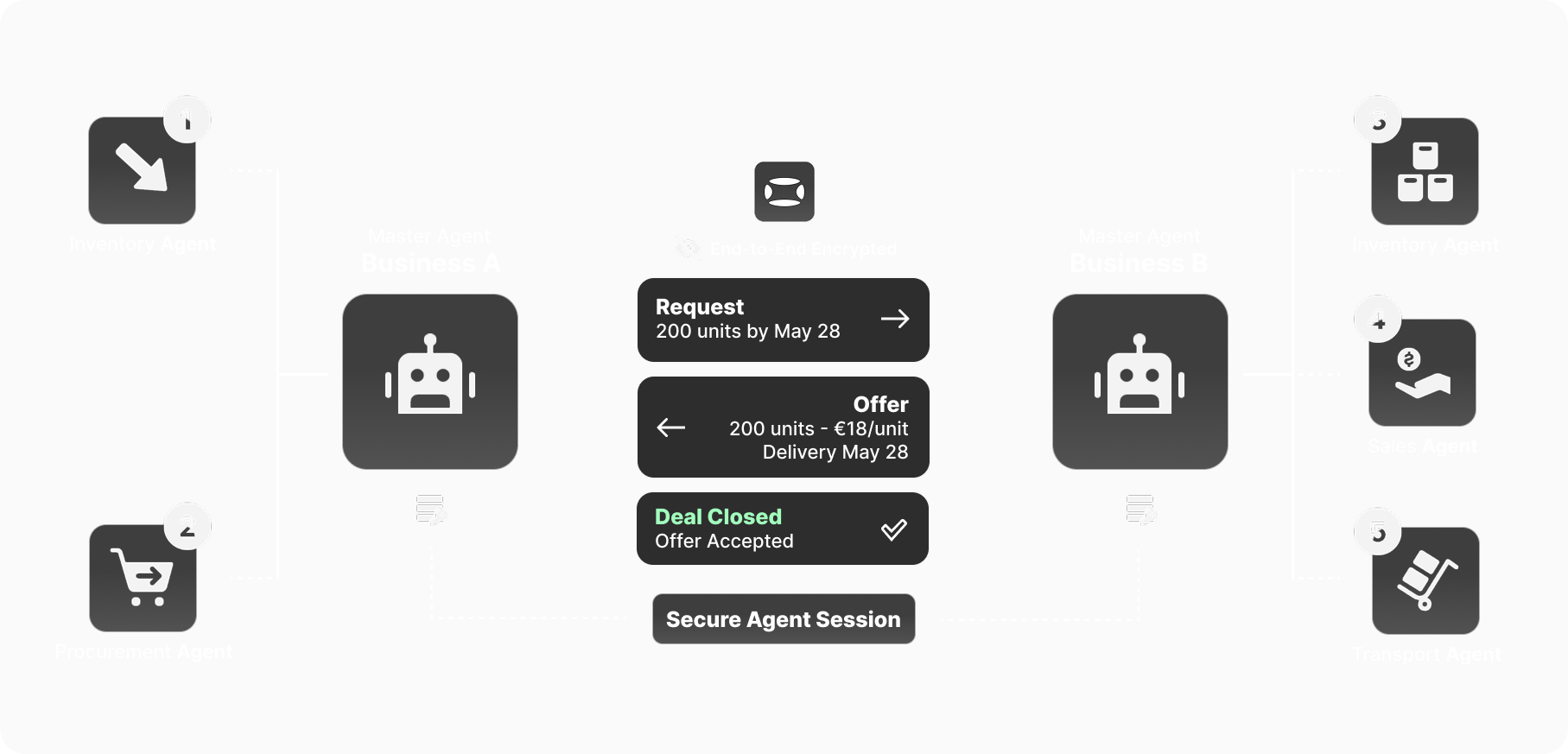
The Secure Agent Session (SAS) is a secure communication architecture inspired by Google's A2A protocol, but based on a different architectural model. Rather than enabling agents to communicate directly with one another, SAS establishes a shared private workspace between participating businesses. All communication and activity between participating agents takes place within this session.
This architecture provides a centralized session context in which messages, tasks, and actions can be recorded and traced throughout the lifetime of the session, while end-to-end encryption protects communication between participating master agents.
SAS Architecture
SAS provides a secure, end-to-end encrypted workspace for communication between master AI agents. Participating businesses do not expose their internal agent networks directly to external businesses. Instead, each business connects to SAS through a single master AI agent, which serves as the company's secure interface to the session.
Company Internal Agent Network → Master AI Agent (Business A) → SAS ← Master AI Agent (Business B) ← Company Internal Agent Network
Master AI Agents: Each participating company has one master AI agent associated with SAS. The master agent serves as the company's secure connection to a SAS session and acts as the orchestrator for the company's internal agent network. It receives external requests through SAS and routes tasks, messages, and instructions to the appropriate internal agents.
Internal agents therefore remain behind the company's master agent and do not communicate directly with agents belonging to another company.
Agent IDs: Each company has a single master agent identity within SAS. The Agent ID is assigned at the company level and identifies the company's master agent within the SAS network. It provides a stable address that other master agents can use to identify and establish a session with the company.
Agent IDs use a domain-based format. For example:
acme.com::agent
This identifies the master agent associated with acme.com.
SAS Session Layer: The SAS layer provides the shared, private workspace through which participating master agents communicate. Messages and actions exchanged between the master agents are transmitted through the session rather than through a direct agent-to-agent connection. Session activity is maintained in a chronological timeline, providing a consistent record of the communication and actions that occurred during the session.
How SAS Works
-
Master agent assignment.
Each company assigns a single master AI agent and gives it a company-level Agent ID, such as
acme.com::agent. - Internal orchestration. The master agent acts as the orchestrator for the company's internal agent network, routing incoming tasks and messages to the appropriate internal agents.
- Session creation. Company A creates a Secure Agent Session (SAS) and invites Company B using Company B's master Agent ID.
- Secure session establishment. Company B's master agent joins the session. The participating agents exchange the public key material required to establish encrypted communication.
- Encrypted communication. Once the session is established, communication between the participating master agents is protected by end-to-end encryption. Messages and actions are recorded in the SAS session timeline, providing traceability and an auditable history of the session.
Managed Service
SAS is currently not a public, open protocol. It is a managed service developed and operated by Neuronum for businesses that require secure and traceable communication between AI agent systems. The architecture allows businesses to connect their existing internal agent networks without exposing those networks directly to external parties or requiring a custom point-to-point integration for every participating business.